From feasibility to engineering prototypes, advance software and hardware through experiments and stage gates.
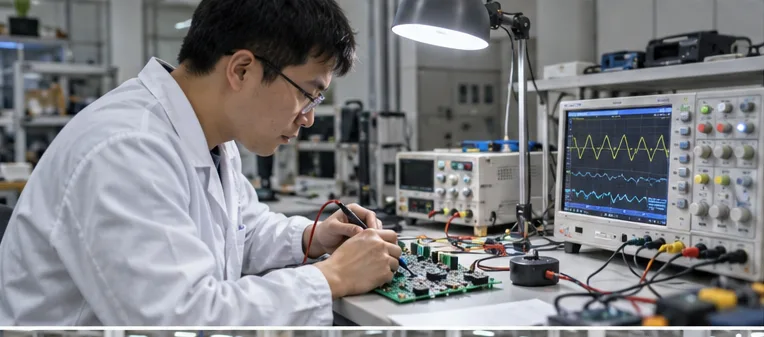
Original AI-generated concept scene; not a real customer, device or project result.
Project boundaries
Define the problem, baseline, environment and constraints. Turn assumptions into measurable experiments; distinguish research, proof of concept, engineering prototype and production product.
Experiments and risks
Define experiment matrices, measurement, calibration and versions. Test supply, thermal, power, communication and safety risks early; failed hypotheses are valid stage outcomes.
Stage decisions
Agree continue, revise or stop conditions per stage. Allocate budgets by validation stage and use evidence for iteration, without guaranteeing unknown technologies will succeed.
What we can develop
Feasibility, requirements modeling, technical routes and experiment design.
Embedded firmware, edge compute, sensors and device communication.
Hardware/software prototypes, interfaces, integration and engineering tests.
Pre-production review, manufacturability, test fixtures and technical handover.
IoT, robot peripheral interfaces, machine vision and automation trials.
Sensing and edge systems for agriculture, logistics, buildings and energy.
Test fixtures, inspection software, remote diagnosis and firmware updates.
Technical reviews, contracted validation and research pilot collaboration.
From requirements to handover
Requirements and authorization: define the problem, owners, data and interface rights.
Plan and baseline: agree scope, risks, budget, deliverables and acceptance.
Prototype and pilot: validate critical flows and recovery in controlled environments.
Integration and acceptance: review test evidence, not demonstrations alone.
Handover and maintenance: deliver docs, training, access, backups and iteration plans.
Scenario and solution studies
Concept studies illustrate design and acceptance, not completed customer projects.
 Original AI-generated concept scene; not a real customer, device or project result.