From feasibility to engineering prototypes, advance software and hardware through experiments and stage gates.
Original AI-generated concept scene; not a real customer, device or project result.
Data and collection definitions
Inputs include specifications, schematics, dimensions, protocols, experiments and environment data. Trace devices, samples, calibration and software versions; keep confidential materials out of unauthorized public model services.
Interfaces and integration
Interfaces may use serial, CAN, Modbus, Ethernet and queues; verify electrical, timing, data and safety requirements individually. Validate industrial, robot and energy control chains separately; web demos do not control production equipment.
Operations and handover
Handover BOM, versioned designs, assembly/tests, known issues and alternatives. Confirm supply, production, certification and field support separately; if stopped, deliver evidence and transferable work with transparent progress.
What we can develop
Feasibility, requirements modeling, technical routes and experiment design.
Embedded firmware, edge compute, sensors and device communication.
Hardware/software prototypes, interfaces, integration and engineering tests.
Pre-production review, manufacturability, test fixtures and technical handover.
IoT, robot peripheral interfaces, machine vision and automation trials.
Sensing and edge systems for agriculture, logistics, buildings and energy.
Test fixtures, inspection software, remote diagnosis and firmware updates.
Technical reviews, contracted validation and research pilot collaboration.
From requirements to handover
Requirements and authorization: define the problem, owners, data and interface rights.
Plan and baseline: agree scope, risks, budget, deliverables and acceptance.
Prototype and pilot: validate critical flows and recovery in controlled environments.
Integration and acceptance: review test evidence, not demonstrations alone.
Handover and maintenance: deliver docs, training, access, backups and iteration plans.
Scenario and solution studies
Concept studies illustrate design and acceptance, not completed customer projects.
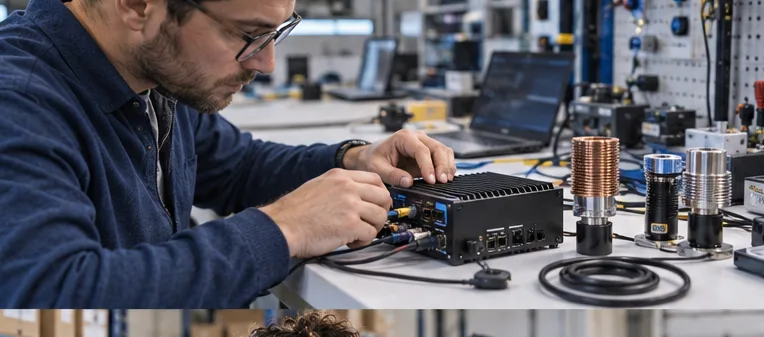 Original AI-generated concept scene; not a real customer, device or project result.