Connect energy resources, edge controllers and dispatch platforms through aggregation, gateways and custom equipment.
Original AI-generated concept scene; not a real customer, device or project result.
Resource assessment
Inventory sites and distinguish installed, available, flexible and eligible capacity. Check load history, SOC, equipment, comfort and contracts; installed capacity is not automatically dispatchable.
Architecture and control
Gateways handle data and local protection; platforms forecast, optimize and audit commands. Constrain policies by equipment and grid limits; retain offline safety and protect critical DCP workloads.
Market prerequisites
Verify local eligibility, aggregation rights, metering, baselines and settlement. Software does not confer trading rights; revenue estimates must state assumptions and risks, not promises.
What we can develop
Aggregation and dispatch for storage, solar, charging, buildings and flexible loads.
Custom gateways, controllers, metering interfaces and device protocols.
Energy forecasting, constrained optimization and DCP compute-energy integration.
Pilot integration, event replay, dispatch audits and operations platforms.
Commercial storage, distributed solar, charging and building energy management.
Coordination studies for campuses, factories, data centers and flexible compute.
Metering, edge EMS, remote operations and alarms.
Demand-response pilots, resource inventories and settlement-data APIs.
From requirements to handover
Requirements and authorization: define the problem, owners, data and interface rights.
Plan and baseline: agree scope, risks, budget, deliverables and acceptance.
Prototype and pilot: validate critical flows and recovery in controlled environments.
Integration and acceptance: review test evidence, not demonstrations alone.
Handover and maintenance: deliver docs, training, access, backups and iteration plans.
Scenario and solution studies
Concept studies illustrate design and acceptance, not completed customer projects.
Campus solar-storage-charging pilot
Project context: Solar, storage and chargers operate separately.
Solution approach: Define constraints and metering baselines, monitor first, then test authorized dispatch.
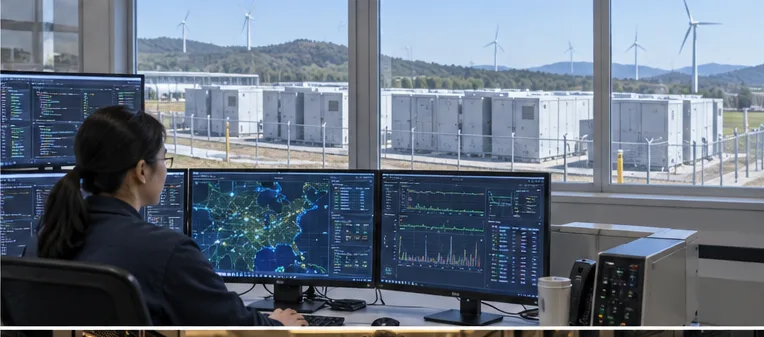 Original AI-generated concept scene; not a real customer, device or project result.