Lightweight edge
For collection, caching, local prediction and lightweight inference. Check always-on power, temperature, storage endurance and offline capability.
Loading page…
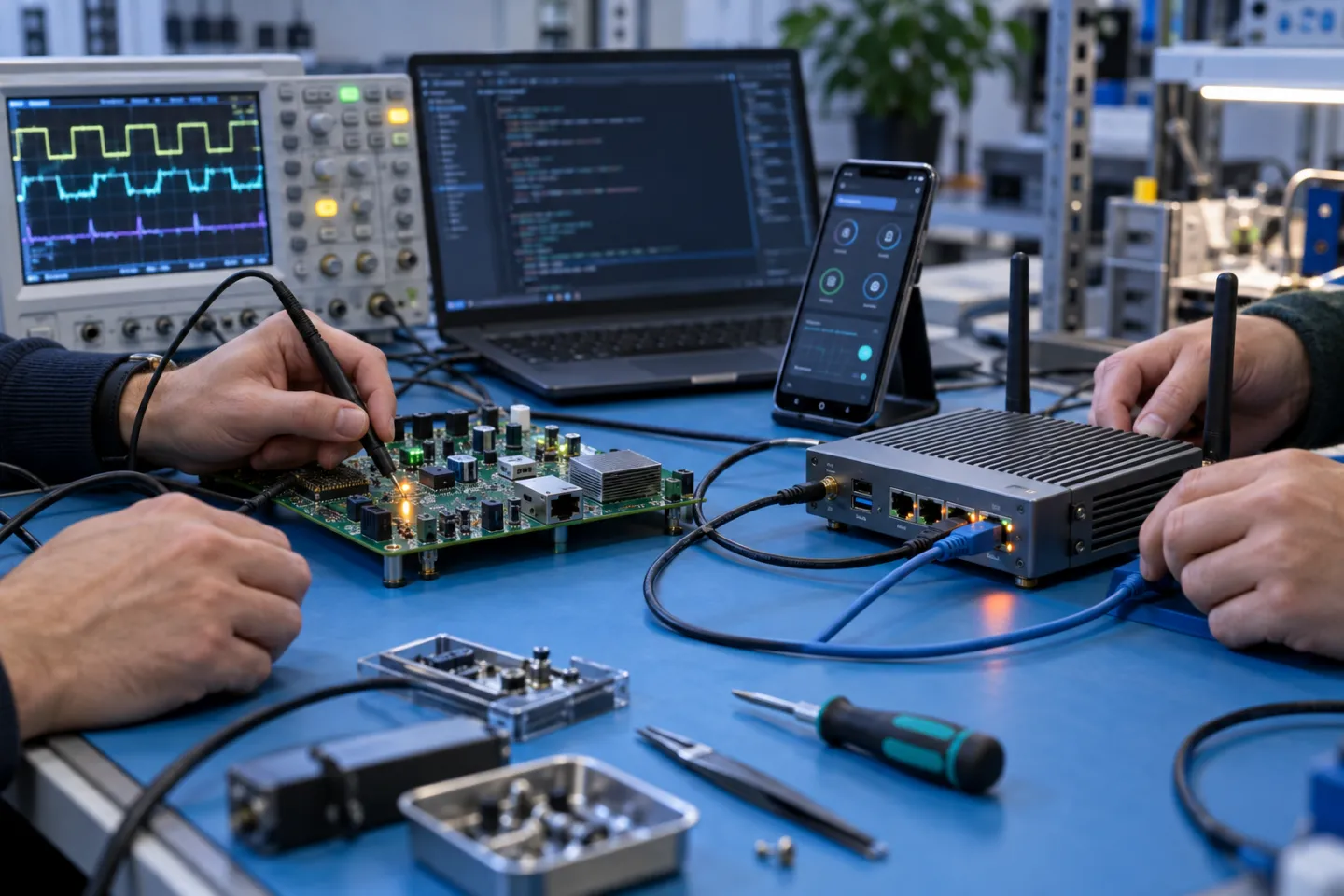
A development concept for routers, embedded devices and firmware debugging. AI-generated scene concept, not a photograph or a delivered customer case.

A workbench explores local models, creative tasks and equipment selection. AI-generated scene concept, not a photograph or a delivered customer case.
Select nodes and controllers for actual models, workloads, power, interfaces and environments. This page explains roles and integration scope, not certified models or guaranteed specifications.
 AI scientific illustration · Not measured data or product specifications
Validate target models and sustained workloads before comparing power, cost and maintenance.
For collection, caching, local prediction and lightweight inference. Check always-on power, temperature, storage endurance and offline capability.
For multiple models, nearby concurrency and workload aggregation. Evaluate memory, bandwidth, cooling and actual throughput, not only TOPS.
For complex inference, training support and cross-node workloads. Assess racks, redundant power, connectivity and centralized operations.
Control scope, device concurrency and isolation determine configuration. A model name is not an engineering assessment.
Integrate protocols, cache states and execute local policies. Test disconnection, reboot and rejected device actions.
Aggregate nodes and device types. Manage point lists, permissions, policy concurrency and control-domain isolation.
Aggregate multi-site data and policies. Assess availability, time synchronization and platform interfaces while retaining site autonomy.
Obtain site authorization and complete point lists first. Existing protection responsibilities remain unchanged.
Meters, circuits and environmental sensors provide state data. Validate accuracy, sampling, clocks and missing-data handling.
Assess inverter, PCS and BMS interfaces. Distinguish readable data from executable actions and verify operating limits.
Evaluate charging, HVAC and interruptible loads. Execute approved actions through existing controllers, with acknowledgments and local confirmation.
Confirm documentation, software licenses and services item by item in the project scope.
Combine modules, carrier boards and interfaces as needed. Check power, thermal design, space, isolation, environment and certification requirements.
Agree on drivers, images, model runtimes, integration services, logs and update recovery. Validate single-site and multi-site functions separately.
Deliver agreed interface documentation, configuration guides and tools. Test connectivity, loads, power and fault recovery.
Power, queues, device health
Permissions, capacity, deadlines
Assign location and time window
Retain native device protection
Results, deviations, traceability
Public logic illustration, not live telemetry. Observations feed validated decisions; execution returns auditable evidence.