T1 Basic node
An edge module reads measurements and states for local forecasting, anomaly analysis and recommendations. It does not replace existing terminal protection.
Loading page…

A workbench explores local models, creative tasks and equipment selection. AI-generated scene concept, not a photograph or a delivered customer case.
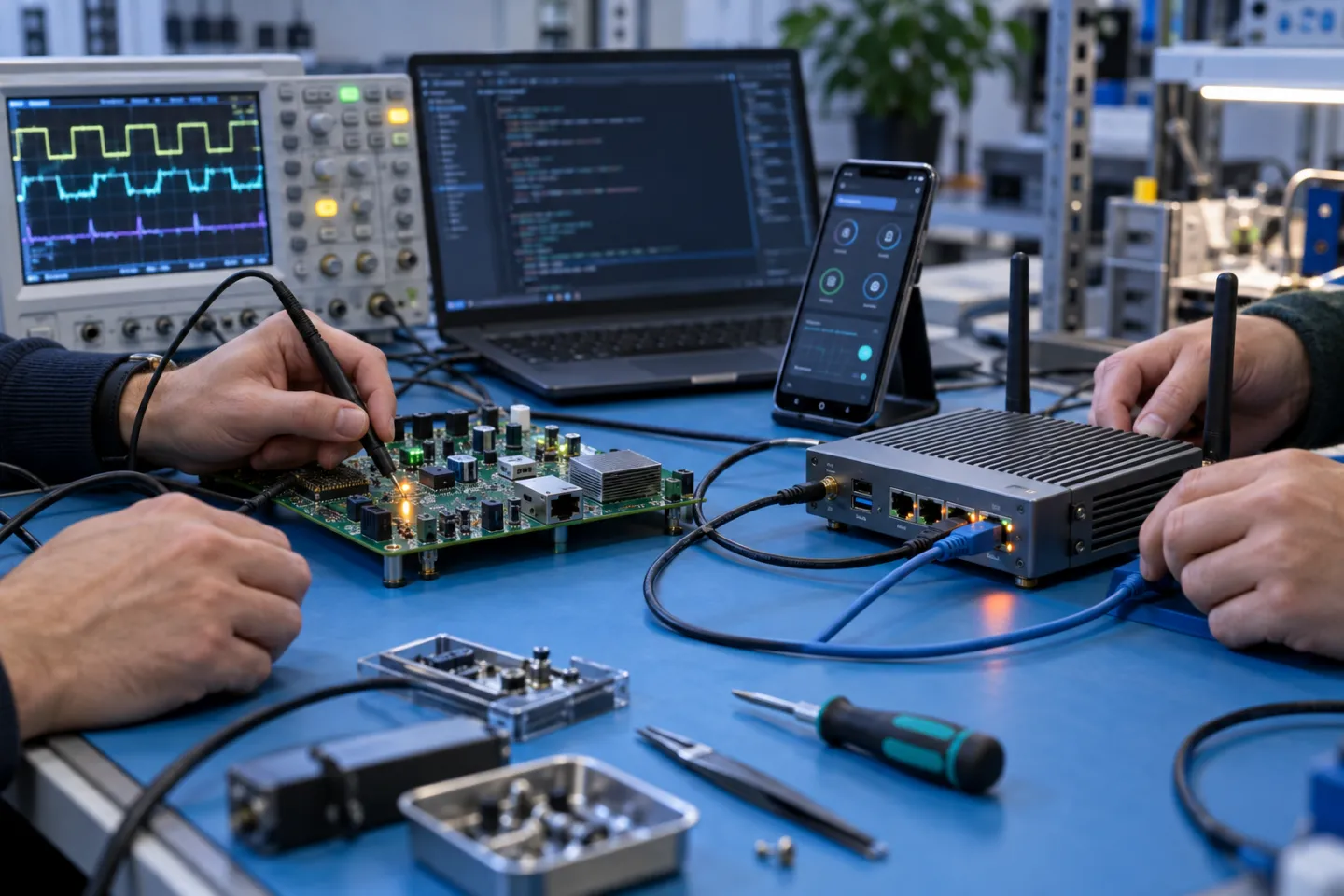
A development concept for routers, embedded devices and firmware debugging. AI-generated scene concept, not a photograph or a delivered customer case.
Connect customer sites and operations through basic, enhanced and regional nodes.
Establish resources, data permissions and business needs before deployment. This public overview describes roles, not internal topology or implementation parameters.
 AI scientific illustration · Not measured data or product specifications
Concept
T1, T2 and T3 identify deployment roles, not fixed capacity or guaranteed performance.
An edge module reads measurements and states for local forecasting, anomaly analysis and recommendations. It does not replace existing terminal protection.
Aggregate campus, community or storage-site resources for nearby inference and coordination, with control and compute separation as required.
Aggregate cross-site data and tasks for trends, orchestration and model maintenance. Local protection must not depend on regional availability.
Measure, assess, then coordinate. Keep accountability and recovery boundaries at every stage.
Check distribution, storage, charging, commercial loads and gateway interfaces. Distinguish permission to read, recommend and control.
Select local or upstream processing by urgency, compute needs, data location and security. Record compatibility, timeout and fallback conditions.
Authorized parties approve AI recommendations before existing terminals or designated systems execute. Retain states, commands, results and deviations without bypassing protection.
Identity supports device governance; it is not a tradable financial asset.
Associate identity with the physical device, firmware and accountable entity. Define registration, activation, changes, revocation and retirement.
Choose verifiable event and version records for the project. Keep raw data in authorized environments; do not assume public disclosure or unrestricted uploading.
Design management functions separately from site control authority.
Manage health, alerts, releases and update recovery. Validate critical changes, provide rollback and retain traceable operation records.
Start with limited integration and fault exercises. Expand after acceptance and handover, assessing capacity and risks independently at each site.
Power, queues, device health
Permissions, capacity, deadlines
Assign location and time window
Retain native device protection
Results, deviations, traceability
Public logic illustration, not live telemetry. Observations feed validated decisions; execution returns auditable evidence.
Confirm site resources and permissions before selecting node roles and validation scope.